
a fermenter's journal
For January 2026

For some time now my friend Rebecca May Johnson has been suggesting a book in which I go through a year of preserves - pickles, ferments, whatever - detailing month by month or week by week not just what you should preserve or what I am preserving at that moment but also what I am cooking or eating with the preserves of last month, last year; an answer to the question I am asked at least once at every workshop I run, but what do I do with it?
I always said good idea and then never did anything about it, partly because I didn’t particularly want to write a recipe book but largely because, working full time in a restaurant which didn’t make much use of ferments and not cooking for my own pleasure as much as I would have liked, it would have felt rather fraudulent to do so. In a piece I wrote a couple of years ago for Filler zine I wrote about idealised kitchens, how in my first book I had written myself a cooking space I do not recognise in any of the kitchens I have worked or lived in and how I didn’t want to do that again.
Since then I have started monthly fermenting classes at Windmill Community Gardens here in Margate and more recently, having stepped away at least for the moment from the restaurant world I am cooking and pickling for myself again, filling up the corners of my tiny kitchen with jars of this and of that.
In short, this seemed the perfect time to revisit Rebecca’s suggestion, not (for now at least) as a book (sorry Rebecca!) but as a regular journal, to keep a record for myself of what I have been preserving that is hopefully useful and inspirational for others too. Maybe it will become a book, in time!
January 2026
A resurgent enthusiasm for putting things in jars came with the need, before we went away for Christmas, of using up the last of the veg bag. So a frequent January snack was a bit of red cabbage, beetroot and red onion sauerkraut on the side of whatever eggs or tinned fish or bread and cheese we were having. I like sauerkraut-based stews (jota, choucroute garni, bigos) but not with red cabbage kraut, which would obviously look quite alarming. I suppose you could add some to braised red cabbage! I didn’t, and the jar is finished.
Leftover from two separate workshops at the gardens I have two cheongs, one made with unripe gooseberries and one with raw quince. These fermented syrups are very easy to make - I’ll detail a recipe when I make another, or you can look up Kenji Morimoto’s - and very rewarding in terms of flavour. I’m planning on using mine for a second fermentation of kombucha, when mine wakes up again - the gooseberry with mountain tea or maybe oolong, the quince with black tea. For now I use some of the gooseberry cheong to sweeten a tisane of sage and mountain tea.
We are starting to build up a surplus of mooli / daikon at the bottom of the fridge so I decide to make some kimchi with it. Traditionally kimchi is made in huge amounts by large groups of people, each sharing their recipes and their expertise. This is the spirit I try to bring to my workshops, which I see as social occasions for mutual learning rather than teaching as such, but even making a single jar at home by yourself can be social if you let lots of recipes in - allow what you do to be guided by the advice of friends, strangers, many hands.
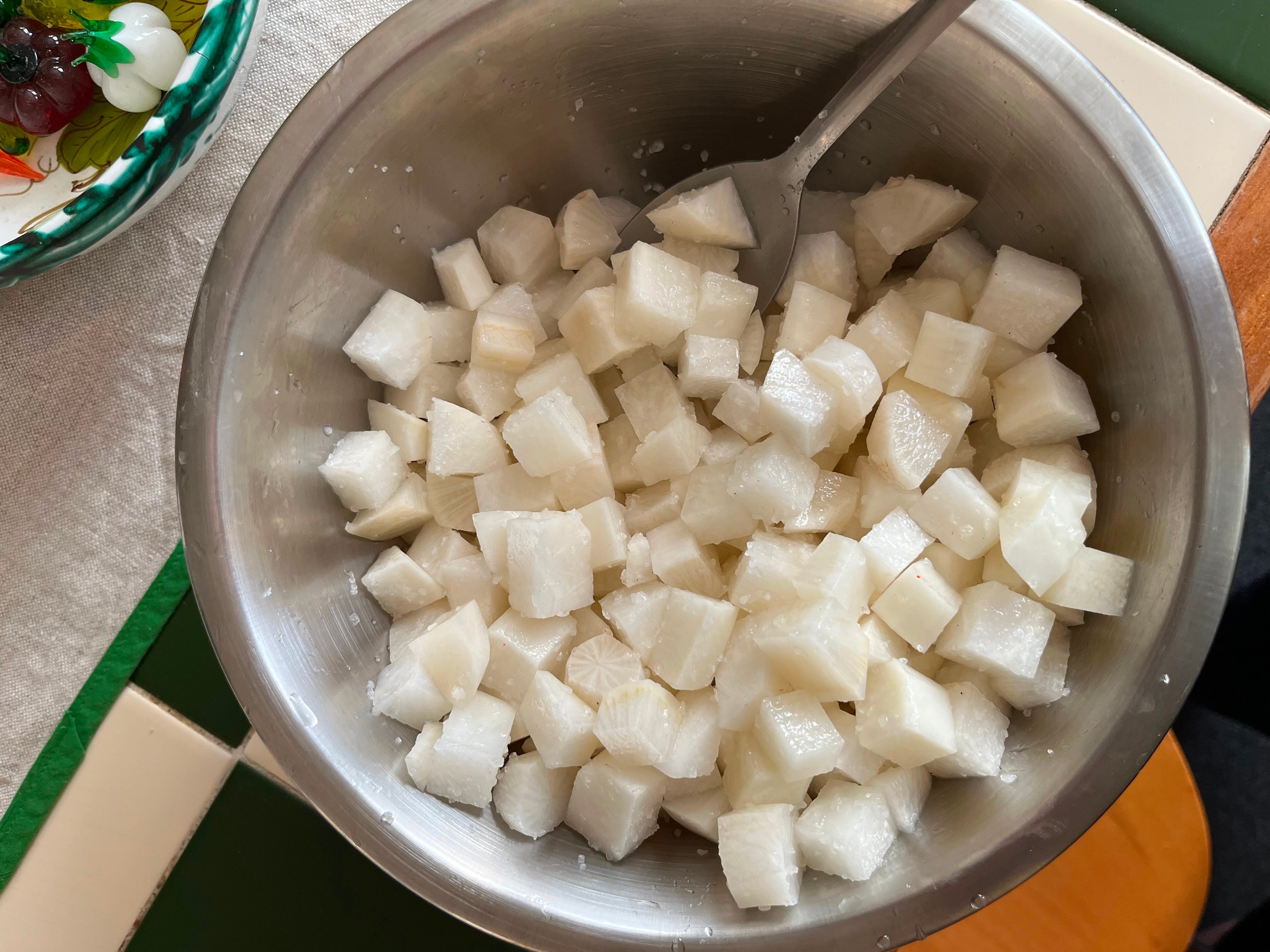
My kimchi recipe is not my kimchi recipe but a reflection of many I have read about or eaten or made before with nothing particularly distinctive about it except the use of cooked rice and pear in the porridge instead of rice flour, which I read about in Songsoo Kim’s writing for Vittles and have used ever since. Feel free to adjust to your own taste and according to what vegetables you have to hand. I used what veg I had from the community gardens; one of the directors of the Margate Crab Museum gave me a bottle of the fish sauce he makes, so I obviously used that too, but I normally just use Squid Brand.
