
8.4.25

in the soil
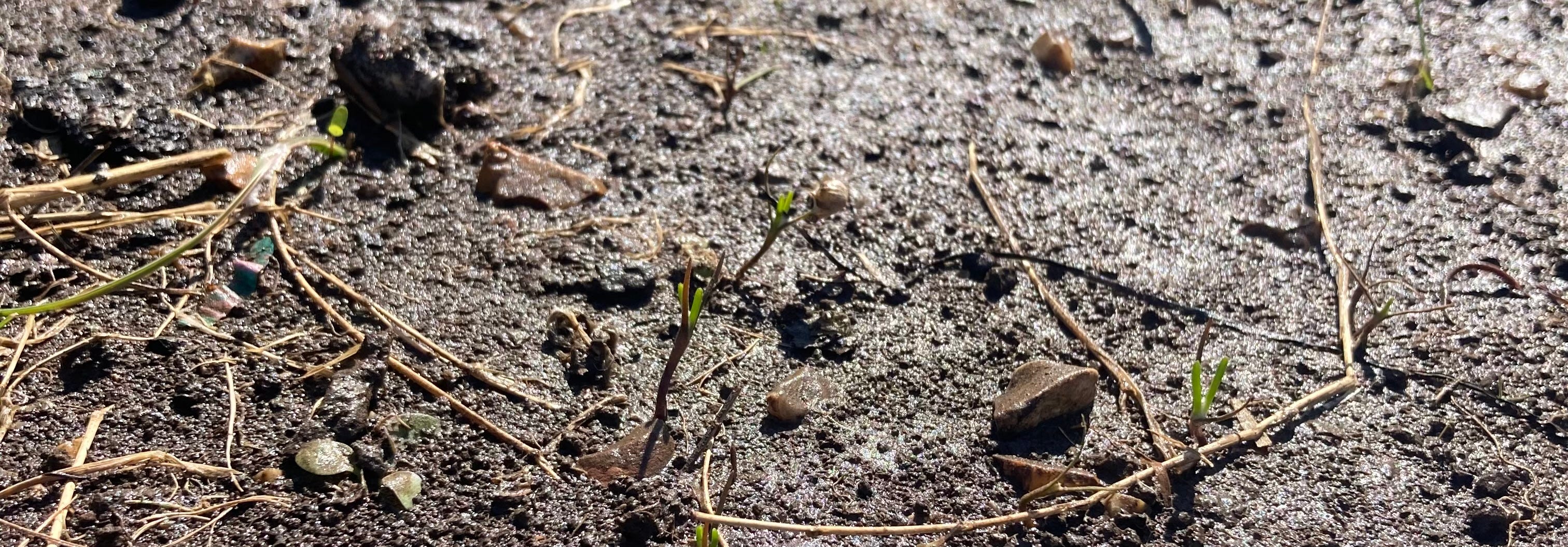
There is always a point at the head of spring in which it seems that nothing new will grow, the overwintered plants just sit there doing nothing, the spring-sown broad beans and the onions put in the ground a few weeks back, the broadcast seeds of herbs yet to show themselves above the earth. Maybe that's it, I think each year, maybe I have somehow depleted my soil of all its nourishment and now nothing more will grow here, not even weeds. Then there is a warm spell and suddenly everything wakes up and grows inches at a time it seems. Last week's bare earth now sprouts seedlings of agretti, dense and marshy by the pond, what I thought was grass is clearly – now I refocus – onion tops coming out, the lovage is four times as high as it was, rooting around I find in the asparagus bed I find spears working their way up and cover them over again. Miniature clusters of blackcurrant, tiny hazelnuts-to-be – everything is wondrously alive! A fat tabby stalks a mouse behind the compost bins, pounces, and struts off with his catch, and that is part of it too, although the mouse might disagree.
in the kitchen
There is always a disconnect between the extreme seasonality of the allotment, tended without the aid of a greenhouse and with almost everything sown directly into the soil instead of raised from seed at home and planted out later, and the seasonality available via our various suppliers with produce stored or grown in heated polytunnels or imported from warmer places. In a sense if you can buy something it is by definition in season, just maybe not its natural or its local season, and there is no point in talking about seasonality at all unless you are also talking about farming techniques and food miles and how all of these things play off against each other – but that is a topic for a much longer and better-researched piece. The manifestation of this disconnect is that while I am mourning the broad beans lost to winter and desperately trying to protect the spring sowing from birds and mice and slugs at work we have broad beans and peas and spring onions and artichokes from Italy and we use them to make a vignarola, the Roman spring stew cooked with olive oil and wine and not much else. Some recipes use ham or pancetta or guanciale which the Romans love to put in everything but as we are using this as garnish for buffalo mozzarella we keep it vegetarian, and anyway sometimes it is nice for vegetables to taste of vegetables.
on the page
Zsuzsanna Gahse's Mountainish as translated by Katy Derbyshire is a kind of rigorous examination, a multi-layered typography its publisher calls it, of mountains, mainly but not only the Swiss Alps, mountains and the ways in which they are experienced and used by walkers, climbers, skiers, loggers and quarrymen, their food and culture, their languages which proliferate in the folds and valleys between peaks and crags. At first it makes me nostalgic for my own mountain dreams, hikes and walks and climbs (I am a very poor climber but I do enjoy it) in the Adirondacks, in Snowdonia. As the book builds (it takes the form of numbered notes, the longest a few pages, the shortest a few words) this nostalgia is replaced by an emotion I cannot quite name – I remember the vision of the mountain in The Enigma of Kasper Hauser – I suppose sublime is the word in the sense that Burke meant it although it is very overused. I read a recipe for something or other involving bacon or maybe chorizo which was described as sublime but yes, this short book is full of the sublimity of mountains.