
3.9.23

in the soil
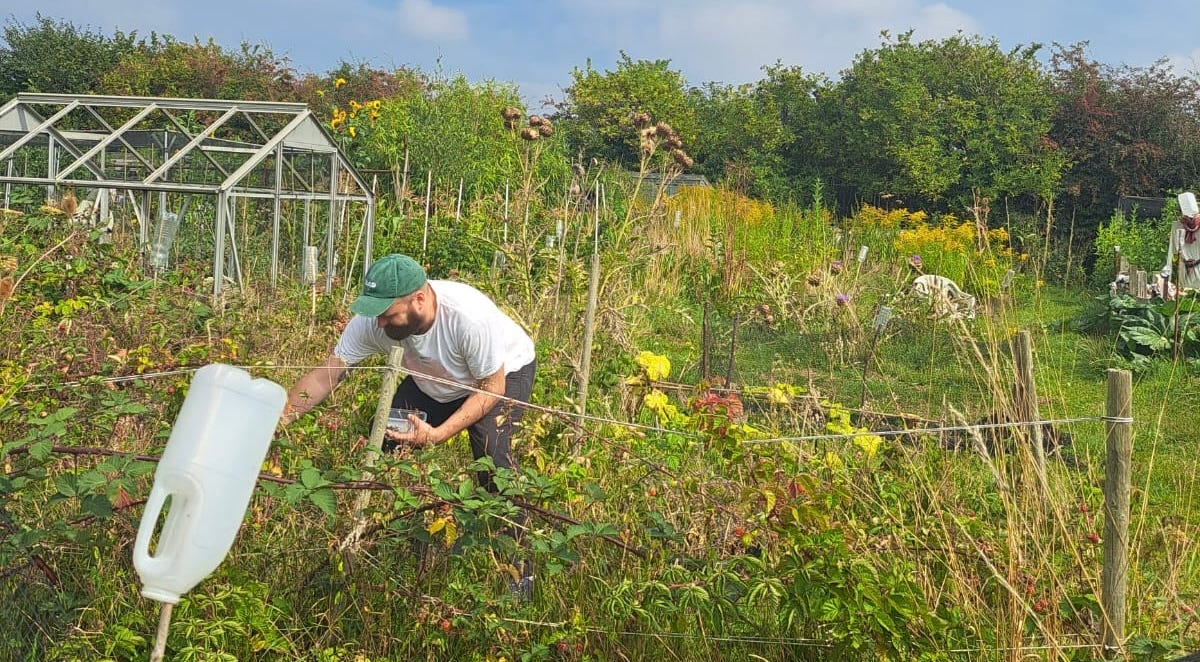
Sunday comes in hot, early September – you’d think it summer but for the colour of air, the state of leaves, the weeds that thrive while grass and greener plants lie dying. Where the artichokes and cardoons collapse down upon themselves, retreat to the safety of root-ball, up the stems of cucurbits a grey death courses the same streams their green life takes. Extremities – plants spread a metre wide – not yet aware of the body’s loss are pushed to a desperate fruiting. At the top of the plot the corrugated plastic beneath the elder is stained with dropping berries, red-wine teeth.
in the kitchen
All summer I have been growing cornichon cucumbers – although more usually, with my sporadic care, grown to a gherkin size – and fermenting them with a method new to me. I have always struggled to keep my pickles crunchy but with a good fermented flavour and this seems to work well. It is a perpetual pickle, and as far as storage goes relies on a desire to eat a great number of pickles.
First you make a 4% brine (stronger than usual means a better crunch) and let it cool down. To this add some aromats (peppercorns, horseradish leaf, garlic, bay leaves, dill or fennel flowers, a dried chilli) and a source of tannin (tannin also means a better crunch) such as blackcurrant or cherry or oak leaves, or a teabag. Then pop in your first load of cucumbers.
These are kind of sacrificial – they will be fermented after about five days, nice and crunchy but not very sour. Take them out and take the aromats and the tannin leaves out and put in some more cucumbers. Leave these to ferment too, and so on. As the brine gets sourer so do the pickles; after a couple of batches you can add a bit more salt to the liquid to keep it happy.
on the page
I am reading Gary Snyder on our/civilised division of land into good (productive), wild (hostile), and sacred (untouchable). What is good becomes private property, what is left is gradually encroached upon. I do not know where in the UK you might find a sacred grove, a rock, a stream; unless they all are. Wildness is similarly hard to come across, the great moors trimmed and managed, the high hills clear of trees only thanks to the steady work of farmed sheep, we have made all the wild land good that we can – the rest has houses on it. We root for the wild and the sacred around the edges of the good, in the feral hedgerows and, yes, in a patch of soil and grass ten rods around.
Love this ♥️ (and pickles)