
15.5.24

in the soil
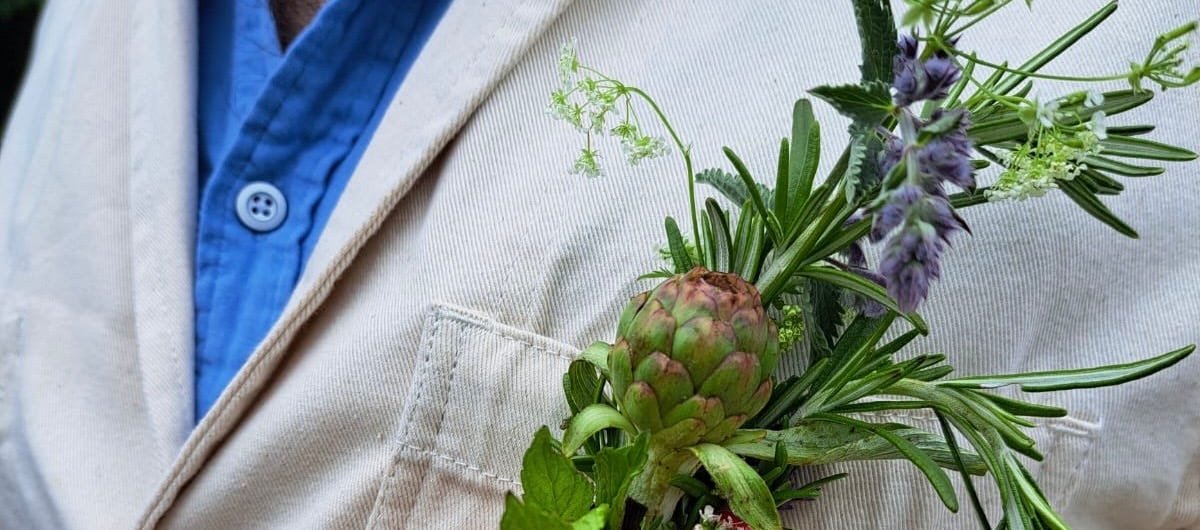
It is strange, I think – not that it is not nice but it is strange – that when we wed or when we die we are surrounded by flowers, artificial flowers, flowers imported from Europe or from Africa, hothouse flowers, garden flowers, wild flowers and grasses and leaves that in other contexts we might call weeds, we like to separate ourselves from the earth but when there is something to celebrate or to remember we let it in. Last week when I dismantled the plastic compost bin on my plot to replace it with something smaller and more natural ten thousand tiny red spiders came out of it, the cracks between panels full of tiny webby nests; out of the flowers comes a single fly the size of a honeybee which, dragged from the community garden or the front garden or the meadow the flower it was resting on was picked from cannot seem to find the way out of its glass-fronted prison, our home.
in the kitchen
We are at that stage of spring-not-quite-summer where there is a disconnect between the local produce we have from our suppliers and the imported Italian fruit and vegetables we can order in, it is tempting to leap headlong into a summer of peppers and aubergines and tomatoes (although even the Italian tomatoes are not there yet) while there are still the quieter greener pleasures to be had of the last few weeks of asparagus, baby artichokes – the broad beans on my allotment are not even grown yet. At work we have added a frittata to our rotation of starters and little plates and there is something very pleasing at this time of year about the combination of eggs (still the season of growth, of Easter) and the greenest things available, a dish not wobbly and ephemeral like a French omelette but dense with vegetable.
on the page
Some books you buy because you wish to read them immediately and some you buy because you wish you were the kind of person who reads those books and some you buy as an investment, knowing that at some point in the future that will be exactly the thing you wish to read, right now, and then there they are waiting for you to read them. I had never quite got round to reading John Berger but then I read Pig Earth and then I read G. and then I read the essay collection Confabulations which is dancing, luminous and now I see there is a new edition of his writing about the miners’ strike and I buy a copy of Barry Hines’ The Gamekeeper with an introduction by Berger and next I will read The Red Tenda of Bologna. It seems impressive, from this vantage point – perhaps I only romanticise – to write (apparently) so stubbornly what you want to write, without the kind of forced coherence, the streamlining of one’s self, that modern media demands.
I saw Ways of Seeing in 1972 and honestly think John Berger changed my life - Confabulations is the book I'm currently carrying around with me, bits of it have left me speechless.
Really pleased to find you writing here, Thom. And 100% echo your thoughts on Berger. I recently tackled a first reading of his fiction – The Foot of Clive. It didn't quite do it for me, but it was the only one on the shelf when caught with a few spare hours to kill in a Bath bookstore... I will definitely be trying G soon. His essay writing on the other hand is almost without parallel. I've been saving Confabulations: too short a volume that I fear I'll be through it too quickly. Do also look up And Our Faces, My Heart, Brief as Photos for some of the most moving writing. And if you fancy half an hour of listening to him, there's the most lovely interview with him not long before his death in the podcast series, A Phone Call From Paul (a series which got me through many walks and days of lockdown). He is fading and taciturn, but still brilliant; his interviewer obviously awed by him.