
10.7.26

in the soil
I am fascinating by the way that my fig tree is growing. It was planted a few years ago as a single bare stick - hardly worthy of being called a trunk - in the middle of the area at the top of my plot that I like to call the wildflower meadow which is in fact composed mainly of goldenrod and daffodils planted by a previous tenant, interspersed with oxeye daisies, the odd poppy and teasel, and the inevitable nettle and bramble coming up through it all. I cleared a space in the middle of this, dug a big hole, and we filled the hole with water before sticking the fig tree in the ground, refilling the hole, and tying the bare stick to an upright post, to make sure it didn’t get blown over. I’m not sure what variety it is except that it is supposed to be cold-hardy enough to withstand the British winter (such as it is), and that it shouldn’t grow higher than a couple of metres, to avoid falling foul of allotment rules; so far it is barely a few inches taller than the original stick. The first year some green shoots and leaves appeared at the top, and I thought it was growing well; these withered and died as soon as we had a cold spell. This was repeated, with new growth never coming from the withered top but always in new places further down the tree, until last year a new shoot came up from the ground, with larger leaves than the original growth had ever managed. Now there are at least three separate stalks, the tallest being the newest, and the whole thing is covered in leaves; it looks like it wants to become a broad shrub, not a tree at all, which is fine by me. I doubt I’ll ever get much fruit off it, at least not for many years, but even the best British figs are always slightly disappointing, and I’m much more enthused about the leaves as a flavour anyway, a kind of toasted coconut I’ve been obsessed with for years. I haven’t made “my” fig leaf wine for ages, although I might now I have my own leaves to put in there. If you follow that recipe, by the way, then halve or even quarter the amount of sugar - I don’t know what I was thinking honestly.
in the kitchen
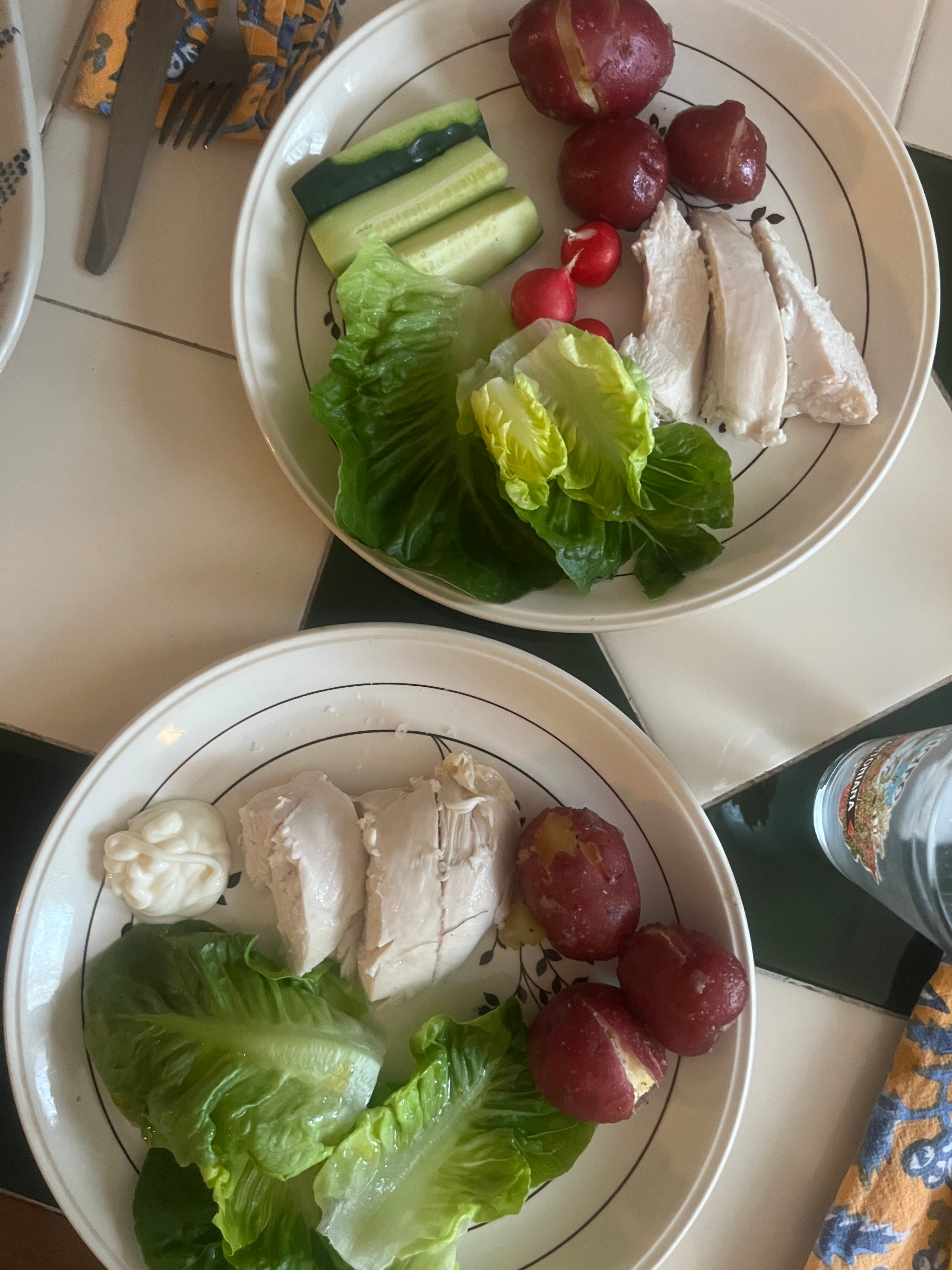
Often when I want a good simple treat I will get a chicken from the butcher or the farmers market and roast it, make a few salads or vegetable sides and have a feast. Then we have chicken salad the next day, chicken broth, etc etc. Now in the midst of what I have seen called our third heatwave of the summer but which seems to me to just be one very hot summer I was craving this meal but obviously had no intention of turning the oven on. So instead I poached the chicken in water with the greens of a spring onion, some garlic, one nice carrot, and a rogue piece of ginger, and while it was resting in its broth very simply prepared some things picked that morning from the allotment - freshly dug Red Rocket potatoes (boiled whole and dressed with melted butter and lots of black pepper), a little gem (from my mother’s plot) that I just cut up and refreshed in ice water and dried and put on the table with half a lemon and salt and olive oil so we could dress it as we liked, and a cucumber (also from my mother’s plot) simply semi-peeled and cut into sticks to dip into salt. Obviously there was lots of mayo on the side, and now we have chicken for salad and lots of broth that I think is light enough to have chilled, one of these evenings, while the weather is still hot.
on the page
The principle of the book-hoarder, as I have said before, is that sometimes you might buy or otherwise acquire and keep a book for a long time before you get around to reading it, and when you do you will often find that now is exactly the right time for you to be reading it, appreciating it more than you would have done had you read it when you first bought it or were given it. Faber sent me a proof of Hannah French’s The Rolling Year: Listening to the Seasons with Vivaldi last August, and while I do normally try to read books I am sent like this in a fairly timely fashion for some reason I put it aside - possibly because I was then still very much wrapped up in my own seasonal book, and didn’t want to be distracted by something with potential resonances, I don’t remember. Anyway, the other week I picked up a novel by Harriet Constable called The Instrumentalist, about the orchestra of foundlings that Vivaldi worked with / exploited throughout his career, and having read and enjoyed it I thought I would come back to French’s book. I have to confess I’ve always thought of The Four Seasons as rather slight background-y music but was happy to be disabused of this notion by French, who very adeptly places the music firmly in the context of the Venetian seasons as Vivaldi would have lived them - summer as a time of overbearing heat and drought interspersed with brutal storms, the stark winters of the Little Ice Age - and also strips away the accumulated layers of familiarity and of modern orchestration to view the concertos as they first appeared, very physical, wildly virtuosic little Baroque puzzles.